Capability Centres
Build a support team that understands your customers
Create a support capability around your channels, service standards, and escalation needs. Ralent helps build and integrate the team while you retain control of customer policy, resolution authority, and experience. Coverage hours and technical depth are agreed in scope.

Work your team can support
Customer enquiries
Support email, chat, or other agreed channels with clear response standards, knowledge, and a defined resolution scope.
Product support
Handle first-line investigation and documented troubleshooting within approved knowledge and escalation boundaries. Technical depth is agreed before hiring or handling customer work.
Customer requests and follow-ups
Support account updates, service requests, follow-ups, and coordination with the internal teams responsible for the next step.
Support operations
Maintain knowledge, queue reporting, quality-review inputs, and records of recurring issues within the working process you approve.
Agreed coverage
Set channels, languages, shifts, overlap, and handoffs around demand. Round-the-clock coverage is a staffing choice, not a default promise.
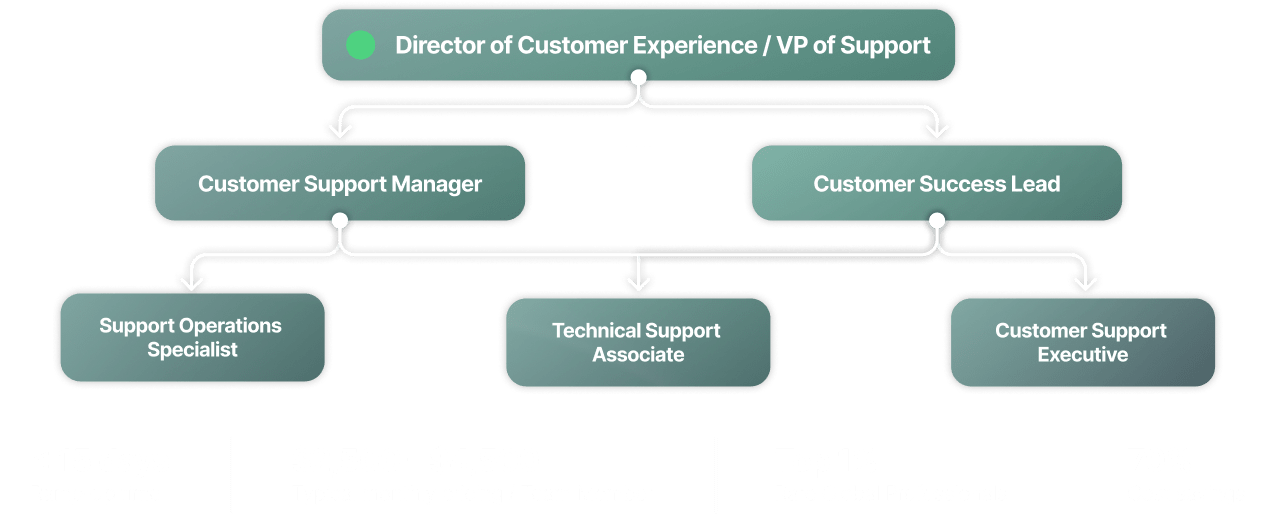
Illustrative Team Structure
Why build this capability with Ralent?
Design knowledge, handoffs, escalation, and review together. Define channels, service hours, and resolution authority around your operation.
Inside your workflow
Work within your helpdesk, knowledge base, and service policies. Agree access, training, and permissions before the team handles customer interactions.
Clear resolution boundaries
Give the team a defined scope and an escalation route to the right internal owner. You retain service commitments and policy decisions.
Reviewable quality
Use agreed standards, interaction samples, and coaching to assess delivery. Review response quality alongside speed, resolution, backlog, and repeat contacts.
Capacity follows demand
Review contact patterns and workload before adding shifts, channels, or roles. More capacity should reduce friction, not add coordination.
From defined work to a working team
Agree roles, access, oversight, and review before expanding the scope.
Map demand
Review contact types, hours, volume, and issues that must stay with your internal team.
Design and hire
Define role depth, channel skills, coverage needs, and leadership before building the hiring plan.
Train and integrate
Set tools, knowledge, response guidance, permissions, and escalation before handling live customer work.
Review and improve
Review interaction quality, resolution, backlog, and repeat contacts against the agreed service measures.

Our Services
Where we plug into your business
Three connected ways to scale. Start where the gap is biggest; add more as you grow.
Capability & Workforce Design Define roles, hiring sequence, and integration around the work your business needs to sustain.
- EOR support
- Dedicated Pods
- Talent orchestration
- Workforce planning and analytics
- Retention and culture systems
Global Operations Architecture Connect governance, systems, infrastructure, and continuity around the way your business needs to run.
- GCC setup and launch
- Operational systems and integration
- Governance and leadership alignment
- Workspace and infrastructure management
- On-ground continuity
Global Expansion Advisory Align market choices, cross-border models, and transition planning with your priorities and constraints.
- Market-entry strategy
- Cross-border operating models
- Cost and reinvestment planning
- Change management
- Defined implementation scope
Latest Insights

From Automation to Agentic Ops: What GCCs Will Be Delegating to AI in 2026
In 2026, Global Capability Centres (GCCs) aren’t just automating routine work. They’re moving into agentic operations
-

Tax & Payroll in 2026: Risks Companies Still Ignore
January 30, 2026 -

Cross‑Functional Skill Pods: The Future of Internal Mobility
January 30, 2026 -

Real‑Time Feedback Systems That Replace Annual Reviews
January 30, 2026 -

AI Governance Frameworks Every Talent Team Should Deploy in 2026
January 30, 2026
Clarify coverage before adding headcount
Reveal. Reframe. Rebuild.
A no-cost diagnostic to clarify support structure, coverage constraints, and the next step.

FAQs
Which customer support work is suitable for an offshore team?
Start with work that has clear knowledge, system access, and resolution boundaries. The scope may include customer enquiries, first-line product support, or customer operations. More complex work needs the right expertise and internal escalation support.
Can the team cover different time zones?
Coverage can be designed around your customer hours. Shifts, overlap, handoffs, and escalation availability must be agreed before launch. Not every team needs or includes 24-hour coverage.
Will the team use our tools and protocols?
The team is designed to work within your helpdesk, knowledge base, and service procedures. Access, training, and approval requirements are part of onboarding.
How do we assess service quality?
Agree a small set of measures for the work, such as response quality, resolution, backlog, and repeat contacts. Review interaction samples alongside the numbers so speed does not come at the expense of a correct answer.
Does this guarantee better customer satisfaction?
No team model guarantees that result. Customer experience also depends on your product, policies, knowledge, and resolution authority. A dedicated team gives you a structure to review and improve those factors.