Global Operations Architecture Build scalable offshore operations
Design the governance, systems, and operating backbone behind global capability centres. Build clear accountability and control around the work, with responsibilities agreed for your model.
Most offshore models focus on delivery. We focus on design.

Challenges we address
- Fragmented processes and inconsistent quality
- Unclear decision rights and governance
- Limited visibility into offshore performance
- Cross-border dependencies and operating risks
- More headcount without stronger outcomes
The structure behind a working capability centre

GCC setup and launch

Workspace and infrastructure

Systems and integration

On-ground continuity

Governance and leadership
How ownership works
You set direction. Operating responsibilities are agreed for the model, not assumed from its label.
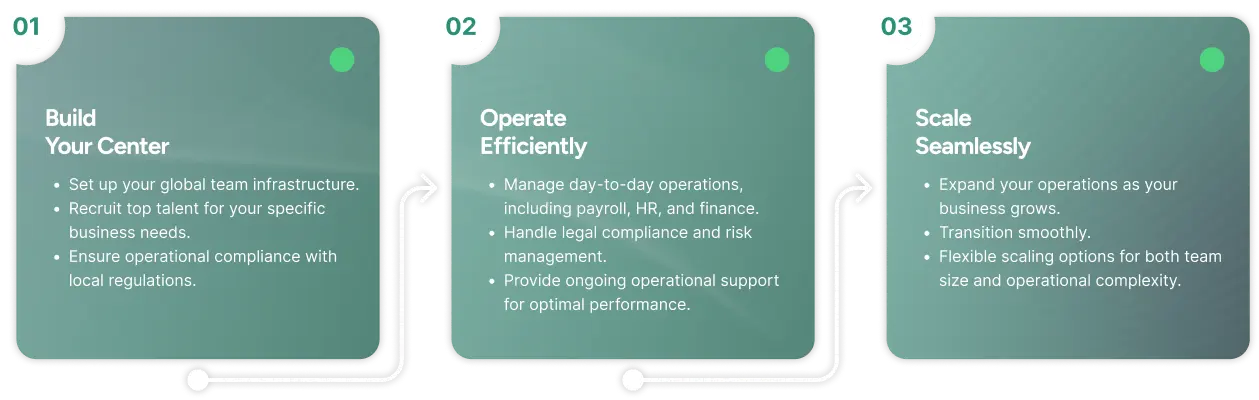

Build around the functions you need
Connect the functions that benefit from long-term capability. Define the work, leadership capacity, and controls before building the team.
Sales & Marketing
Support pipeline operations, campaigns, content, and revenue reporting within your priorities and approval structure.
Finance & Accounting
Support recurring processing, close activities, reporting, and analysis under your finance controls.
Customer Support
Design coverage, resolution authority, quality review, and escalation around your customer journey.
Legal & Compliance
Build documentation and workflow capacity within defined professional oversight and jurisdiction requirements.

Make performance repeatable
Define where work sits, who owns each responsibility, and how exceptions are handled. Connect roles, systems, and review cadence around the way your business runs.
What we define
- Function split and workflow ownership
- Role accountability and decision rights
- Communication and reporting cadence
- Quality standards and review checkpoints
- Performance measures and exception routes
Control that works day to day
Governance should clarify decisions, not add reporting for its own sake. Agree the controls, responsibilities, and review rhythm that fit the work and location.
Governance includes
- Leadership authority and decision rights
- Risk and compliance coordination
- Data-handling and access responsibilities
- Performance review and escalation paths
- Documentation and specialist-review requirements
Improve the structure you have
Review bottlenecks, reporting, rework, tools, and operating risks. The next step may be targeted redesign rather than a new centre.
What the assessment covers
- Workflows, handoffs, and recurring bottlenecks
- Reporting, tools, and quality controls
- Decision ownership and escalation routes
- Operational dependencies and risk exposure
- Priorities, owners, and review measures
Connect design to the work
Bring people, process, and infrastructure into one plan, with responsibilities defined before the next stage.
Connected operating model
Bring systems, workflows, and reporting into one working structure.
Clear decision rights
Set owners, review points, and escalation paths.
Defined control responsibilities
Agree specialist review, statutory obligations, and local responsibilities explicitly.
Infrastructure that fits
Plan workspaces, technology, and support around the agreed model.
Continuity as you grow
Document responsibilities and review performance before widening the scope.
Case Studies
The work matters. So does the evidence.
Know what to change before building more
Reveal. Reframe. Rebuild.
A no-cost diagnostic to identify structural gaps and operating constraints before building your next capability.

FAQs
How is this different from outsourcing?
The focus is the operating structure behind your capability: ownership, governance, integration, and continuity. Outsourcing generally contracts for a service or output. The actual responsibilities depend on the model and scope.
How long does a GCC setup take?
Feasibility, hiring, infrastructure, access, and governance create different dependencies. We agree a staged plan after scoping. Launch readiness and stable operations are separate milestones.
Can you work with an existing offshore operation?
Yes. An assessment can identify bottlenecks, unclear ownership, and gaps in systems or governance. The next step may be a targeted redesign rather than a new centre.
What governance model is best?
The one that fits your work and leadership structure. It needs clear decision rights, useful measures, review cadence, and escalation routes. A template cannot settle those choices without context.
What does an operations assessment cover?
The agreed review can examine workflows, handoffs, reporting, tools, quality, accountability, and operational risk. Scope and required specialist review are established before starting.
Which functions belong in a GCC?
Start with work that benefits from long-term capability, knowledge retention, and a connected operating base. The role mix depends on business priorities, management capacity, and the controls the work requires.